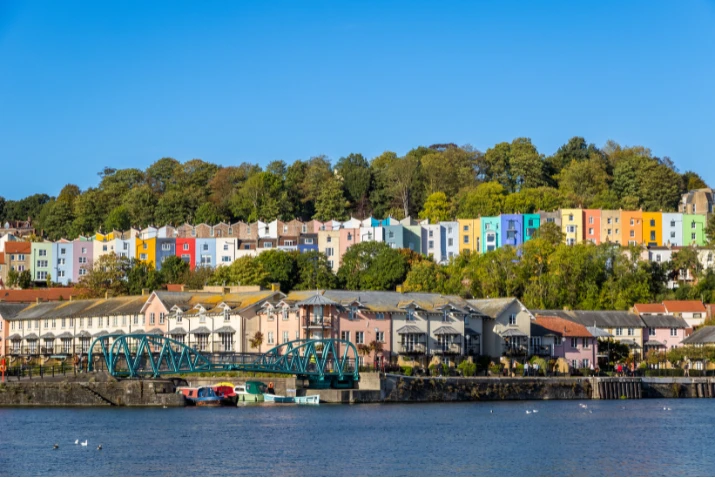
Bristol is an incredible city that has always been shaped by its ability to adapt. It began as a medieval port built around a bridge and harbour, grew into one of Britain’s most important trading cities, and later expanded through major infrastructure projects such as the Floating Harbour, Temple Meads railway station, Clifton Suspension Bridge and Avonmouth docks.
As industry, transport and housing developed, the city absorbed surrounding villages and expanded through new suburbs and council estates, including Knowle West, Southmead, Hartcliffe and Lawrence Weston.
Today, Bristol is once again facing the challenge of growth. Strong demand from residents, workers and students is putting huge pressure on housing, with prices and rents sitting above many regional and national benchmarks. For investors, this creates both opportunities and risks.
On the one hand, high demand can support rental income and long-term capital growth. On the other, Bristol is one of the most unaffordable areas outside London, whether people are buying or renting. Anyone investing in the city will therefore need either deep pockets, strong local knowledge, or the ability to spot opportunities where value can be added.
Major regeneration schemes, including Temple Quarter, Hengrove Park and Western Harbour, are central to delivering the many more homes required in the city.
However, Bristol has repeatedly overcome physical and economic constraints through reinvention, and the key question now is whether its next wave of regeneration can help tackle the city’s severe housing shortage while improving connectivity, affordability and quality of life.
5 key considerations before investing in Bristol property
There are several things anyone looking to invest in residential property in Bristol needs to understand before making a decision.
1. Prices and rents
According to Office for National Statistics data, the provisional average house price in Bristol in June 2026 was £357,000, up 3.5% year on year. This made Bristol the fourth highest average house price area in the South West.
Average prices by property type in Bristol in June 2026 were:
• Detached properties: £696,000
• Semi-detached properties: £452,000
• Terraced properties: £388,000
• Flats and maisonettes: £246,000
However, as with most cities, it is important to understand how trends vary by property type. In Bristol year on year:
• Detached properties rose by 2.7%
• Semi-detached and terraced properties rose by 4.6%
• Flats increased by 1.5%
As is often the case, especially in cities, although it will not apply to every flat or every location, price growth tends to be stronger for houses than for flats.
Rents in Bristol
Although rents are high in Bristol, this is largely driven by the high cost of investing in housing. ONS data shows that rents in Bristol tend to outperform many other geographies. However, it is worth noting that they can also go through periods such as 2025 where they dip further, so rental growth is not always consistently upwards.
The average monthly private rent in Bristol was £1,880 in July 2026. This was up from £1,765 in July 2025, an inflation beating 6.5% annual rise. This was significantly higher than rental growth across the South West as a whole, where average rents rose from £1,184 to £1,236 and across the UK, from £1,343 to £1,393.
It’s important to be aware though that average rents disguise the cost of renting different property types and varied number of bedrooms:
By property type, average rents were:
• Flats and maisonettes: £1,506
• Terraced properties: £2,005
• Semi-detached properties: £2,086
• Detached properties: £2,101
Average rents by number of bedrooms in Bristol in July 2026 were:
• One bedroom: £1,223
• Two bedrooms: £1,541
• Three bedrooms: £1,755
• Four or more bedrooms: £2,542
What is interesting from a buy to let perspective is that larger houses do not appear to command the same rental premium they may achieve in some other areas, despite costing much more to buy. This is important for investors, as a higher purchase price does not always translate into a proportionately higher rent.
Source: ONS Housing Prices

2. Will demand continue to increase?
When considering an area for investment, it is important to look at demand before looking at the property itself. Investors need to understand population growth, housing supply, the local economy and specialist housing needs. Without this, you are effectively buying a property and keeping your fingers crossed.
Fortunately, there is a lot of incredible information available, including population data, labour market statistics and evidence on housing need.
Bristol City is currently estimated to have just over 500,000 residents. The population has grown significantly since 2015, by almost double digits at 9.6%, compared with just over 7% for England and Wales.
Growth is expected to continue, with the population projected to rise to around 550,000 by 2032. Importantly for investors, the detail matters. A significant proportion of this growth is expected to come from age groups more likely to rent, with the number of 16 to 24-year-olds projected to rise by 20% which is likely to boost demand for the rental market. There is also expected to be an 18% rise in those aged 25 to 49.
Bristol also has a higher proportion of working-age residents than many comparison areas, with around 71% of the population of working age, compared with 60% in the South West and 63% in Great Britain which shows that although property rents are high, there are plenty of people that are able to afford to buy and rent.
Overall, this suggests that demand is likely to remain strong, which should help support the investment case for Bristol. Much of the projected growth appears to be among younger and working-age residents, which matters in a city where both prices and rents are already high.
3. Does Bristol have a strong economy?
Yes! Bristol appears to have had a strong economy over time and, even when there is a setback, the city seems to bounce back well.
According to Centre for Cities: “Bristol is the strongest performer of all of the UK’s large cities. It has both the highest productivity of any of the group, and the highest share of jobs in knowledge service activities too (and the 6th highest of any of the UK’s 63 largest cities in 2022).”
Wages in Bristol tend to be higher than those in the South West and Great Britain overall. However, it is important to note that, on average, they are not high enough to fully offset the city’s higher rents and house prices.
From an employment perspective, Bristol has a high proportion of people working in management and professional roles which is likely to support affordability for those who can find a suitable home.
According to ONS estimates, 66.5% of employed residents in Bristol are in senior roles, compared with around 54% in both the South West and Great Britain.
4. What is happening with housing supply?
Housing supply is at least, growing in line with the Councils plans. Under the current Bristol Local Plan Core Strategy 2006–2026, they aimed to build 30,600 new homes in Bristol Since the start of the local plan and some good news for those needing a new home is that a total of 33,556 new dwellings have been completed.
So Bristol has increased the number of homes it has delivered. According to the Bristol Development Monitoring Report 2025, planning permissions have also increased, reaching around 18,500 in 2025 which bodes well for the future.
However, the real problem for Bristol is not about how many homes they build, it is the lack of homes that people can afford to buy and rent.
More homes are needed for:
• People on benefits
• Bristol’s large student population
• Young renters
• Working households
• Families who need affordable homes
Unless these homes are delivered, Bristol could find itself in the difficult position of having more people than it can properly house.
This may be positive for some investors because demand is likely to remain high. However, it is clearly challenging for those who need an affordable property to live in and any investor that can find a way to deliver to those in need would likely to have well tenanted properties.
Sofia Lopresti, assistant lettings manager at Romans Bristol, says, “Working in the heart of Bristol allows us to cover the whole of the city and our area knowledge helps us advise our landlords on where the right areas to invest are and where our applicants want to rent.
"Bristol is a lively and colourful city with something exciting happening in every area. The market is always busy and with more and more people re-locating here for work, there is not enough property for the demand. It’s a desirable place to live and more people should invest here.”

5. Capital growth and yield
Over time, Bristol has delivered one of the highest levels of house price growth among UK cities. However, since 2005, it is worth noting that prices have, on average, only kept pace with general inflation.
That said, this is still better than many cities across the UK and suggests that, with careful investment, it may be possible to secure good long-term capital growth.
The challenge is that Bristol’s high property prices can make it harder to secure strong rental yields. However, the city’s large student population and strong rental demand mean there may still be opportunities for investors focused on income, provided they choose the right property in the right location.
According to Zoopla: The average gross rental yield in the UK is currently 5.8%. This is based on the average buy-to-let property costing £270,045 and the UK’s average rent being £1,301, according to our latest data. So, a good gross rental yield is typically 5–8%, while anything under 4% is considered below average.
For the South West and Bristol, yields of around 5.6% may be achievable by spending around £300,000 on a property and securing a monthly rent of around £1,394.
However, where a property can be let by the room, rents may be around £600 to £700 per room. This could support investors who are more focused on income than capital growth, although they will need to take account of HMO rules, adding additional costs to licensing, management costs and local planning restrictions.
Overall investment view
Overall, Bristol is an incredibly strong city to invest in, provided you have the funds to buy well. It has a strong economy, a growing population, a large student market and significant regeneration activity.
Capital growth over time has tended to keep pace with inflation, and more recently rents have risen ahead of inflation. However, high property prices mean investors need to be careful. The wrong property, bought at the wrong price, could struggle to deliver the desired return.
The key is to invest in a property that matches your investment objectives, whether that is capital growth, income, or a combination of both. It is also important to work with professionals such as Romans Bristol and Romans Clifton who understand the local market and can help identify the right property for you to deliver returns in the short and long term.